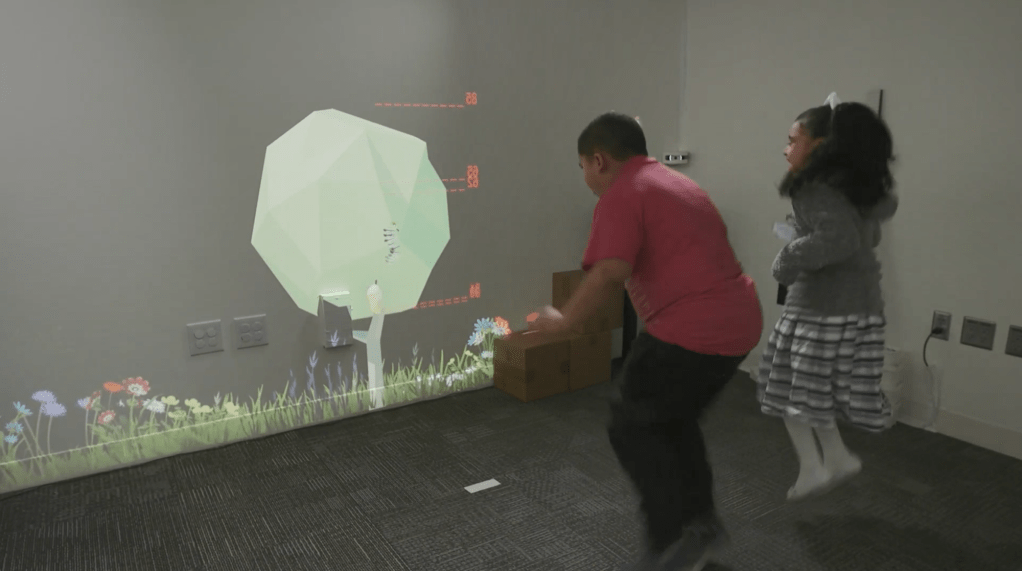
Kid Space: Enhancing Education through Play Using an Augmented Reality Smart Space
The Challenge
How can we leverage ambient compute technology to enhance learning?
As a researcher in a lab focused on spatial computing, my job was to understand and advocate for user needs while researching applications for smart spaces. For this project, we were interested in exploring the domain of education with a special focus on reducing screen time for children
My Role
As lead designer for Kid Space, I handled all creative and user-centered tasks. This meant I wore many hats ranging from experiment design, character design, gamification, 3D modeling and game engine configuration, to pedagogical research and digital agent dialog scripting. The needs were ever-changing and required me to regularly learn new tools.
Key Skills
- Novel User Interface Design
- Interactive, physical prototypes
- Content Design
- Multidisciplinary collaboration (extensive!)
- 3D modeling and game engine prototyping
- Design Thinking
- User Testing
- Game design
- Workshops for collaborative design
- Interaction design
Understanding what makes an educational smart space compelling
Prior to the pandemic, an exploratory round of research showed that parents were eager to improve their children’s digital educational experiences. However, they were concerned about increasing screen time and the potential negative impact on social and physical skills. Leveraging user interviews with educators and parents, my team and I set off to explore how we might meet this need. Four key themes emerged:

Social – Support play between multiple children and a digital, conversational agent

Educational – Prioritize educational value in a variety of subjects.

Renewable – Design for replayability with customization and creativity at its core.

Physical – Promote physical activity and integrate real-world interactions.
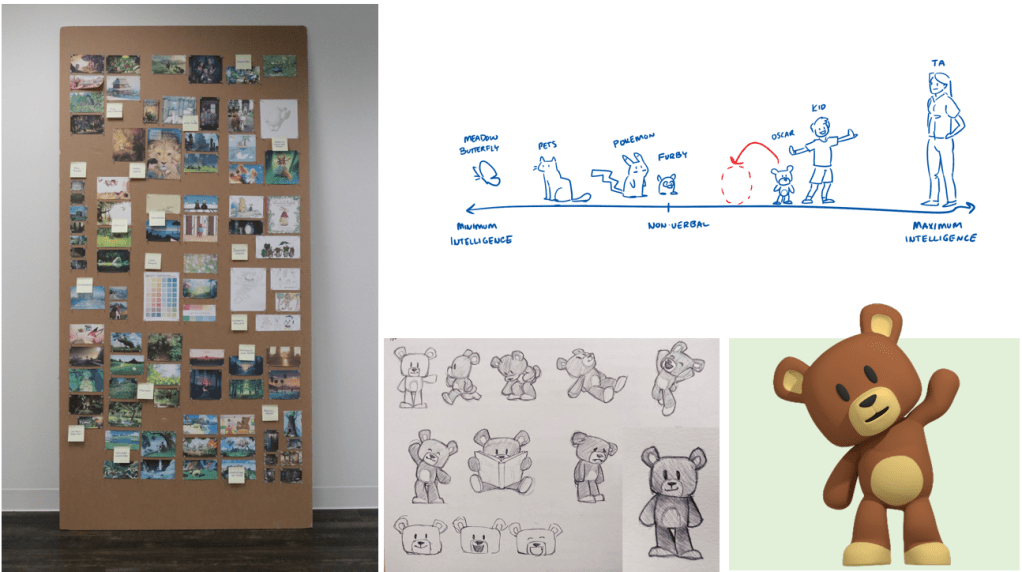
Exploring interactions with Oscar, an intelligent digital agent
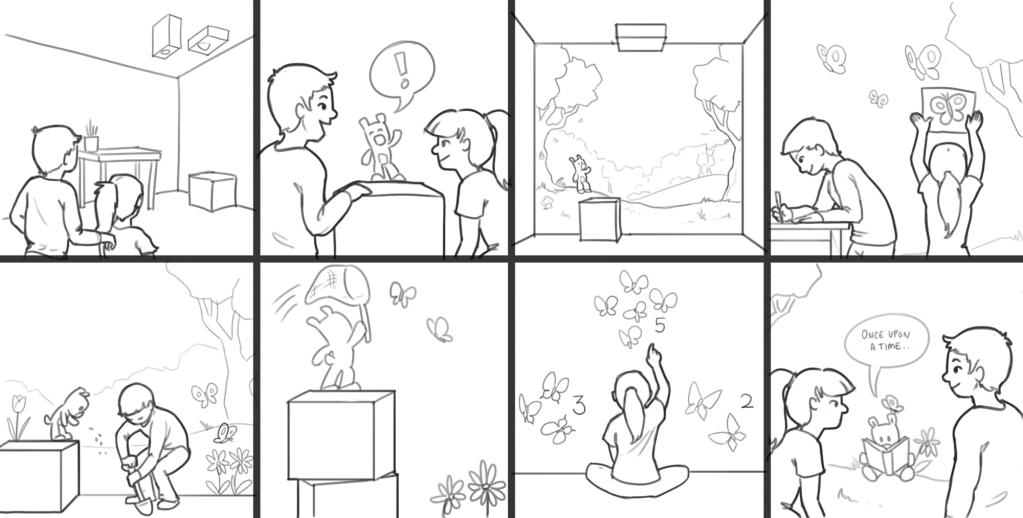
A late-night experiment in the lab revealed that a projection-mapped, interactive character had incredible potential. I began designing for an interface in the only way possible with such a novel interaction modality: extensive physical prototyping. Interaction design was at the forefront of this project and paved the way by establishing requirements for the technical groups. Wizard of Oz testing allowed the team to quickly iterate though concepts and test them with children-sometimes on the fly during a research session!


Prototyping a room-scale interface
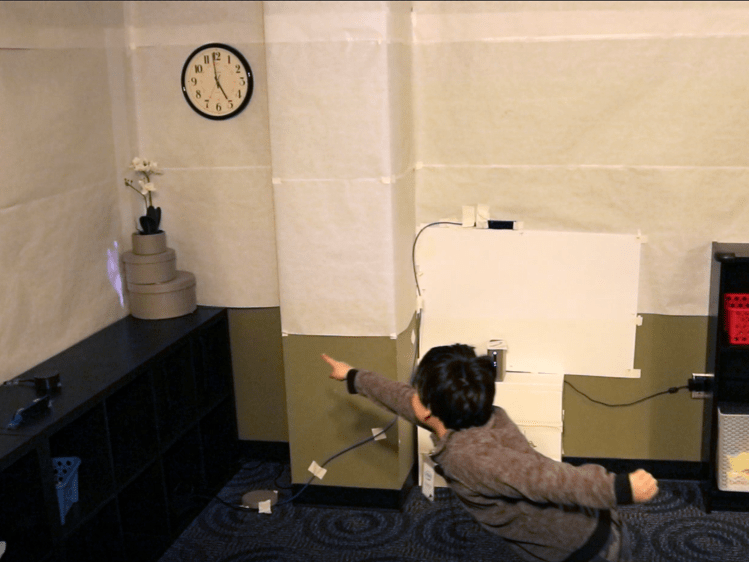

Kid Space is a room-scale experience, so I designed novel interaction modalities to take advantage of full walls and the floor. This included touch capabilities on the wall, object recognition throughout the play space, and activity recognition. Additionally, I was the voice of Oscar. I wrote his scripts and voiced him during Wizard-of-Oz pilots until the conversational agent was mature enough for use with multiple children simultaneously.
Integrating pedagogical content and interactions
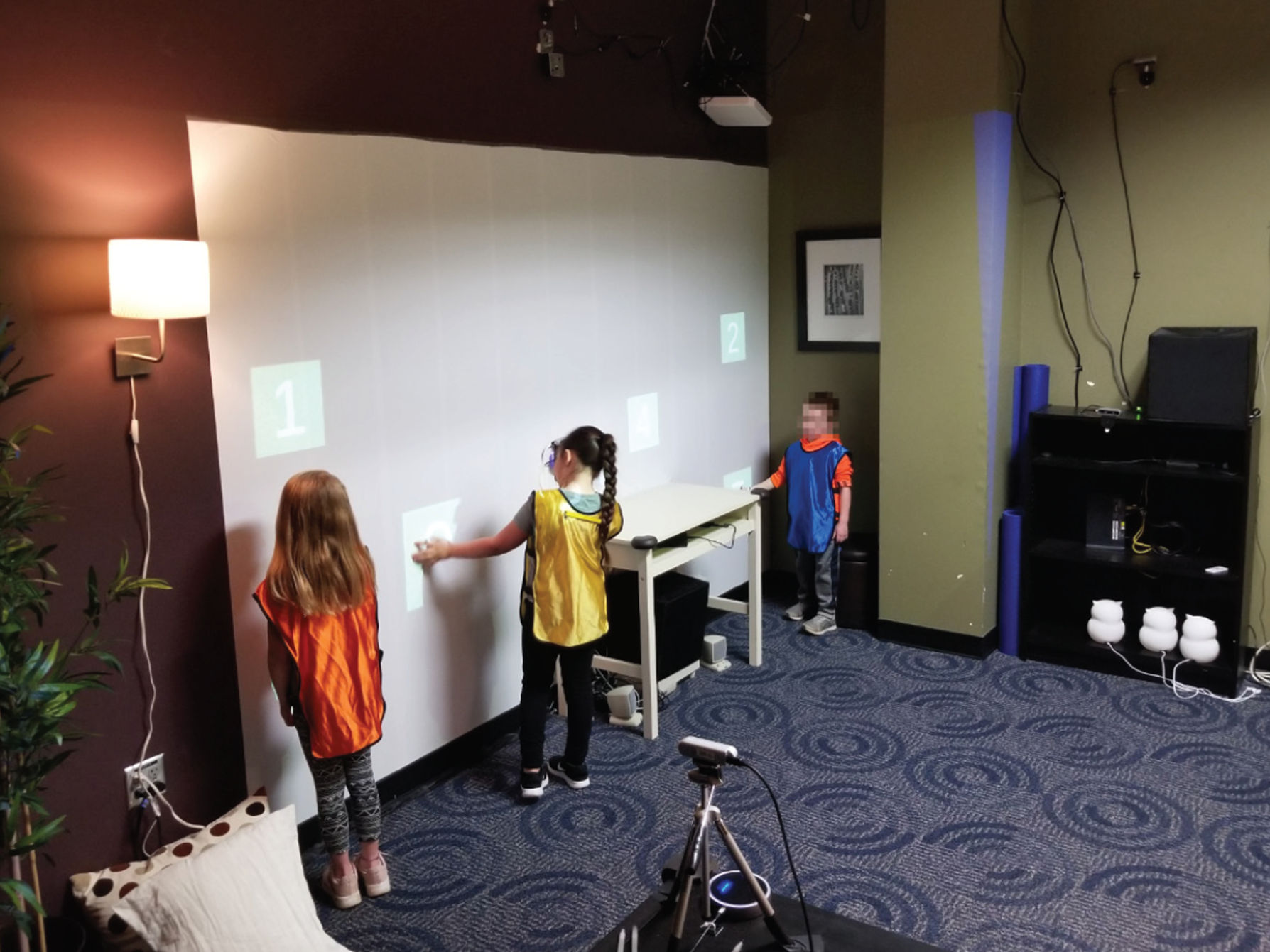
While we collaborated with engineering groups to make the physical space functional, I also spearheaded content and experience design. Leveraging pedagogical research and user feedback, I designed a series of curriculum-aligned games that seamlessly integrated the pillars of Kid Space along with principles of game design.
Deploying Kid Space in an Elementary School
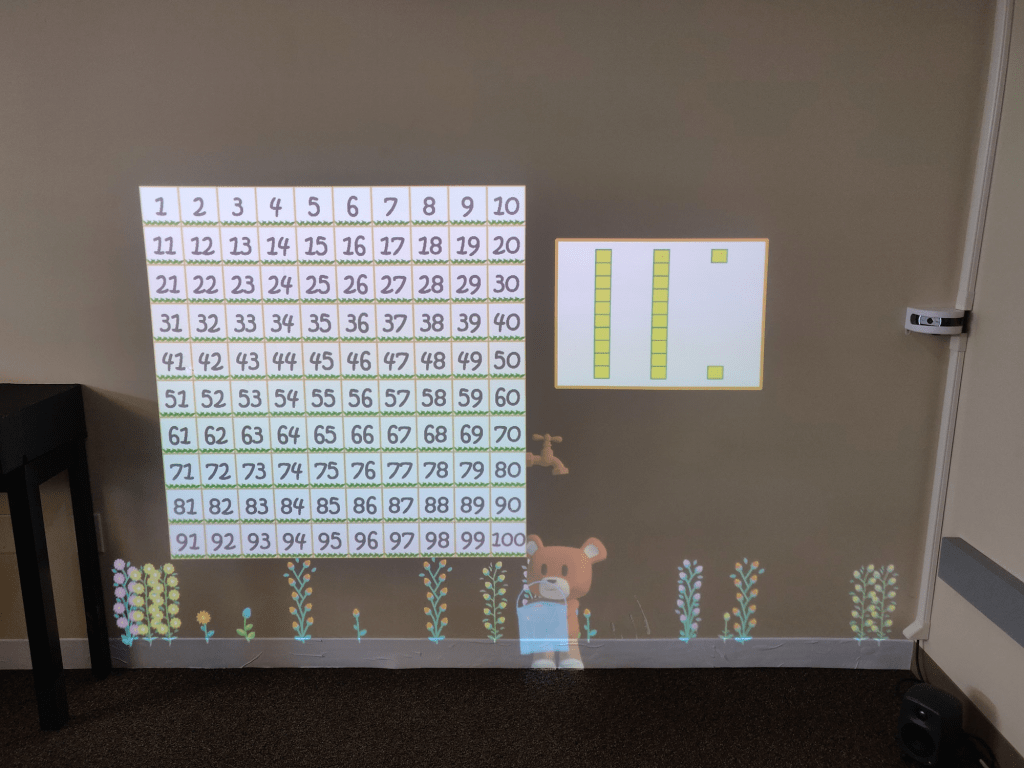
The final stage of researching Kid Space was deploying the project in an elementary school. By collaborating with a local first grade class, we were able to pilot a fully autonomous version of Oscar to play math games with students in school.
The Impact
What began as a late night experiment in the lab evolved into a years-long research project. The endeavor united multiple teams into one of the most extensive collaborative efforts in our lab that resulted in dozens of publications, patents, and tech hand-offs to internal business organizations. Capabilities we developed in Kid Space lead to core components of Intel products on the market today. Kid Space trail blazed multi-user natural language interactions and sense-making of pose, activity, and gesture in a spatial context.
Additionally, live deployments of Kid Space proved high levels of engagement with the content, increased physical activity, and high social engagement between students.
Further Reading
The technologies developed during Kid Space touched on many capabilities and products coming from Intel Labs. In addition to patents and publications, Kid Space has also received some press:
- Kid Space: Re-imagining the Potential of Technology-Mediated Learning
- Intel Labs Shares Kid Space at Home Research with the Educational Community at Bett UK 2023
Publications:
- What is the impact of a multi-modal pedagogical conversational AI system on parents’ concerns about technology use by young children?
- Exploring Kid Space in the wild: a preliminary study of multimodal and immersive collaborative play-based learning experiences
- Kid Space: Interactive Learning in a Smart Environment
 Becky Chierichetti